Almost none of the expensive problems in a first fragrance production run come from the perfume. They come from the order in which decisions were frozen: artwork approved before the formula, components ordered without overage, a reference sample nobody retained, market documentation left until after printing. Each of these is cheap to prevent and expensive to discover. A brand that writes the sequence down before the first bulk order avoids most of them without spending anything extra.
Key takeaways
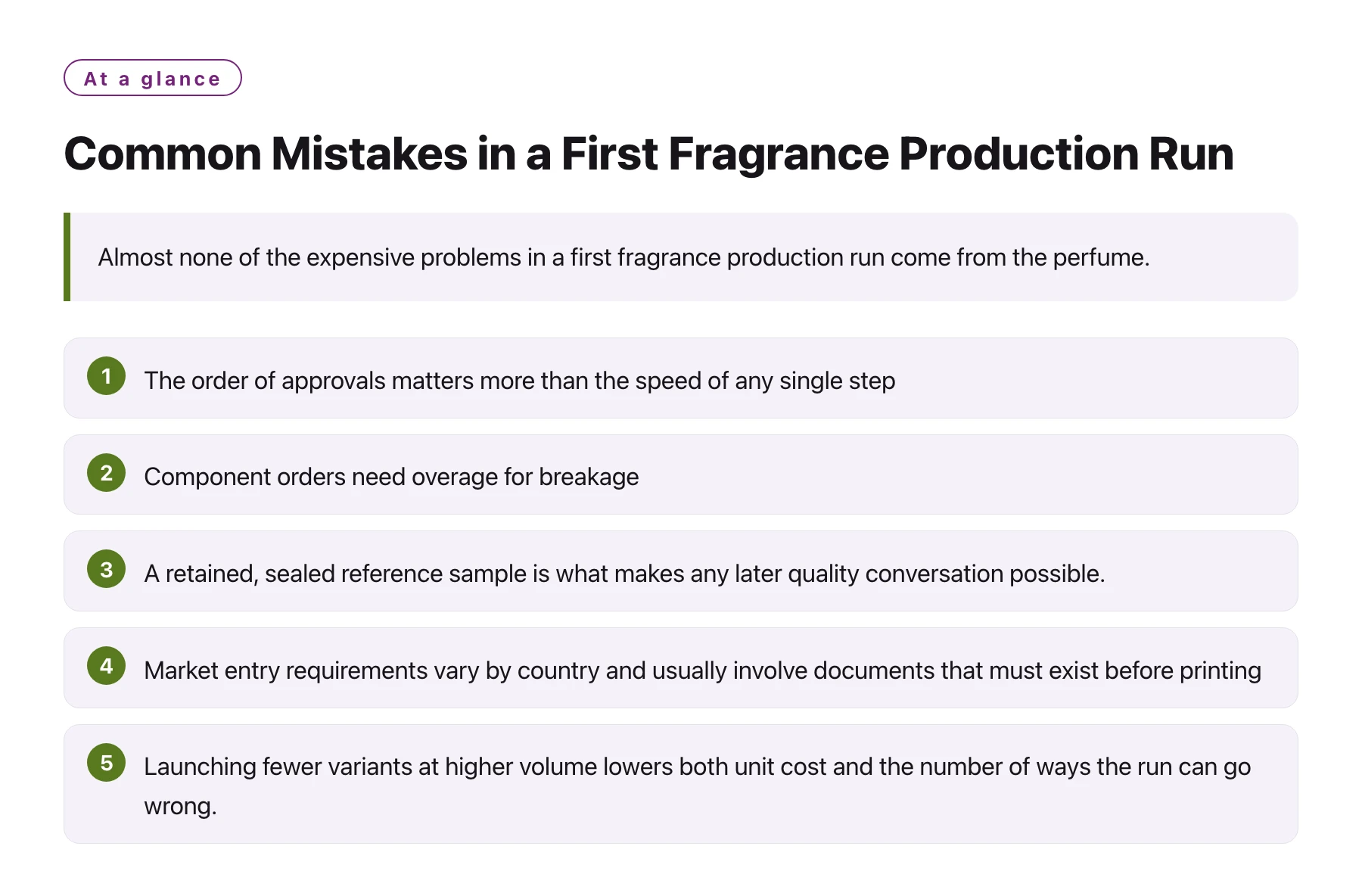
- The order of approvals matters more than the speed of any single step, because artwork depends on the frozen formula.
- Component orders need overage for breakage, damage and quality rejections, or the packing line stops short.
- A retained, sealed reference sample is what makes any later quality conversation possible.
- Market entry requirements vary by country and usually involve documents that must exist before printing, not after.
- Launching fewer variants at higher volume lowers both unit cost and the number of ways the run can go wrong.
The first bulk order is where a fragrance project stops being a design exercise and becomes a logistics operation. Sampling rounds are forgiving; production is not, because material has been bought, printed and scheduled, and every correction has a real cost attached.
The encouraging part is that the failure modes are well known and highly repetitive. They show up across categories and price points, and they are almost always sequencing errors rather than technical mysteries.
What follows is a short list of the ones that hurt most, what each costs, and the sequence that avoids them.
The mistakes that cost the most
These are ordered roughly by how much damage they cause when they surface late. None of them requires a specialist to prevent; all of them require somebody to decide the order of operations before the project starts.
Approving artwork before the formula is frozen
Ingredient declarations, allergen wording and net content all depend on the finished formula. If cartons and labels are printed first, any later formula change becomes a reprint, and on decorated or custom-structured packaging that is one of the largest avoidable costs in the project.
The correct sequence is short and non-negotiable: freeze the formula, write the specification, generate the declaration, then approve artwork.
Ordering components with no overage
Glass breaks, pumps arrive with defects, cartons get damaged in handling, and quality checks reject units. A component order sized exactly to the fill quantity will run out before the line finishes. The standard practice is to order a sensible margin above the target quantity, and to treat that margin as part of the plan rather than as waste.
The same logic applies to the fragrance compound and to any printed material where a minimum print run is involved.
Skipping the retained reference sample
When a sample is approved, an unopened unit of that exact batch should be set aside, labelled with the batch code and the approval date, and stored cool and dark. Without it, every later discussion about whether a batch has drifted is conducted from memory, which rarely resolves anything.
This is the cheapest quality control instrument available, and it is the one most often omitted on a first run. Xuelei retains a sealed sample from each approval round, and asking any manufacturer to do the same costs nothing.
The most common single cause of a late launch is not a manufacturing fault but an approval bottleneck. A brand collects comments from the founder, the designer, the marketing lead and a retailer, and each arrives separately over several days. Every round of sampling waits on the slowest reply. Fix it with one rule: a single named person consolidates all internal comments into one written response per round, with a deadline. That change alone shortens most projects by weeks and costs nothing.
The sequence that prevents most of them
- Freeze the scent firstApprove the formula and the wear profile before any packaging artwork work begins, and record the approval date.
- Write the specification sheetA single document describing the formula, the pack, the fill quantity and the tests that apply. Everything else refers back to it.
- Confirm market documentationCheck labelling, notification and responsible-party requirements for every market you will sell in before artwork is finalised.
- Retain a sealed control sampleLabel it with batch code and date and store it away from light and heat, untouched.
- Order components with overageAgree the margin for breakage and rejection in writing, and confirm lead times for the longest item on the list.
- Inspect the first off the lineCheck the first saleable units against the approved reference before the full run is filled, not after.
What each mistake costs and how to stop it
| Mistake | What it costs when found late | Prevention |
|---|---|---|
| Artwork approved before the formula | Reprinting cartons, labels and any decorated packaging | Sequence: formula, specification, declaration, artwork |
| No retained reference sample | Unresolvable disputes and unnecessary reformulation | Set aside a sealed, labelled control at every approval |
| Components ordered without overage | Line stoppage, a short shipment or a rushed reorder at premium price | Agree a breakage and rejection margin before ordering |
| Documentation left until after printing | Rejected shipments, relabelling or a delayed market entry | Confirm market requirements during packaging design, not after |
| Too many variants in the first run | Higher unit cost, more approvals and more ways to fail at once | Launch fewer scents and buy volume where it reduces cost |
| Supplier chosen on unit price alone | Poor documentation, unclear change control and hard-to-resolve quality issues | Compare specification, testing scope and change terms as well as price |
Notice how many of the right-hand entries are process decisions rather than purchases. That is the useful pattern in this list: the expensive mistakes are almost all cheap to prevent, provided they are prevented before the run rather than during it.
Putting the checklist into the contract
A checklist that lives only in a project folder will not survive contact with a busy launch. The items that matter should appear in the quality agreement or the purchase order, where they become obligations with dates rather than good intentions.
Name the documents and the deadlines
List the specification sheet, the certificate of analysis, the stability report and the safety documentation as deliverables, with the stage at which each must be provided. Market entry rules differ by country, and public guidance such as the cosmetic safety information published by Health Canada is a useful starting point for understanding what a regulator expects before a product is sold [1].
If the product will be sold in the European Union, scientific advisory opinions on fragrance allergens and other safety topics are published and updated over time, and they feed into the labelling rules that affect artwork [2]. That is one more reason to treat the declaration step as a milestone rather than a detail.
Agree who pays for change
Formula changes, material substitutions and artwork revisions all cost money, and the argument is always about who caused them. A short clause that assigns responsibility for each type of change, and requires written approval before work proceeds, removes almost all of that friction.
It is also worth agreeing how safety questions are handled. Fragrance materials are assessed through structured risk evaluation published by industry bodies, and a supplier who works with those assessments routinely will already have a view on which materials carry restrictions in your product category [3]. Ask for it before the formula is frozen, not after.
Work with a process that has run before
None of this is exotic. Manufacturers that produce fragrance regularly in Guangzhou and comparable manufacturing centres have usually seen every item on this list and built the sequence into their standard programme. Working with a manufacturer that has run these steps many times, such as Xuelei, mainly removes the risk that a first-time brand invents its own order of operations.
That does not remove the brand's own responsibilities. Someone on the brand side still has to own the approval calendar, consolidate the feedback and confirm the market documentation. The supplier can supply the process; only the brand can supply the decisions.
Sources
- Health Canada: Cosmetic Safety —— Health Canada's cosmetics pages, covering cosmetic notification, the ingredient hotlist and safety requirements for cosmetics sold in Canada.
- EU Scientific Committee on Consumer Safety (SCCS) —— The EU scientific committee that issues opinions on the safety of cosmetic ingredients, including fragrance allergens and their labelling thresholds.
- IFRA: Safe Use and Fragrance Science —— IFRA's explanation of how fragrance materials are scientifically assessed for safe use and how those conclusions are applied by the industry.
Frequently asked questions
What is the most common mistake in a first perfume production run?
Approving packaging artwork before the formula is final. Ingredient declarations and allergen wording depend on the finished formula, so a late change forces a reprint. Freezing the formula and generating the declaration before artwork avoids the most expensive single error in a launch project.
How much overage should be ordered on bottles and cartons?
Enough to absorb breakage, handling damage and quality rejections during filling and packing. The exact margin depends on the component, the line and the supplier, so it should be agreed in writing at the quotation stage. Ordering exactly to the fill quantity reliably produces a short shipment.
Why do I need a retained reference sample?
It is the only objective record of what was approved. Without a sealed, labelled control from that batch, any later comparison is made against memory, which cannot settle a disagreement. A retained sample makes quality conversations factual and usually much shorter.
Is it better to launch one scent or several?
For a first production run, fewer is almost always better. Each variant repeats the sampling, documentation and approval work, and multiplies the ways the run can be delayed. One well-made scent at a volume that lowers unit cost is usually a stronger start than several under-supported variants.
How can a brand avoid market-specific labelling problems?
Confirm the labelling, notification and responsible-party requirements for every destination market during packaging design, before artwork goes to print. Requirements differ between countries and some of them involve documents that must exist in advance. Building that check into the design stage costs nothing; discovering it afterwards costs a reprint.