How Brewery Equipment Is Packed and Shipped Overseas
A brewery leaves the factory in wooden boxes, and the first document worth opening is not a drawing but the checking list packed with the shipment. Every order passes five inspection steps before it is loaded, and each tank arrives with a data plate showing its pressure-testing record and serial number. That paperwork is what makes a delivery verifiable on the day the truck reaches your yard.

Key takeaways
- Equipment travels in wooden boxes with a checking list, so the crate count and the contents can be confirmed before unloading is finished.
- Five inspection steps run before loading: materials checking, production process, jacket pressure testing, packing and loading inspection, and a finished-product leak test.
- Every tank carries a data plate with its pressure-testing record and serial number, which keeps traceability intact long after installation.
- The published delivery window is 90 to 150 days from deposit to door, depending on the order, so floor, drain and utility works should be scheduled against that range.
What actually leaves the factory
A brewery is not shipped as one welded block. Vessels, frames, pipe spools, panels and fittings leave as separate assemblies, each strapped inside a wooden box and labelled so that the unloading order on site matches the erection order in the drawing. Hermann Biological Engineering, the manufacturer behind these machines, has spent 23 years designing craft brewing equipment and has sold into more than seventy countries, among them the United States, Canada, Russia, Mexico, Brazil, Singapore, France, Kazakhstan, the Netherlands and the Nordic countries, so the packing is planned for sea freight plus a long inland leg rather than for a local delivery van.
A checking list is placed with the shipment. It is a plain document, and its whole value is that it turns a missing fitting into something you notice while the truck is still at your gate instead of three weeks later, when the installer is standing under an open manway with a spanner in his hand.
One practical request is worth making early: ask for case numbering to follow the installation sequence rather than the production sequence. A forklift cannot reach the back of a loaded container, so the first case out ought to be the first case you need.
The five inspection steps that run before loading
A shipment passes five inspection steps, and they run in a fixed order: materials checking, production process, jacket pressure testing, equipment packing and loading inspection, and a finished-product leak test. Taken together they cover the whole order, from the steel that arrives at the factory to the assembly that will hold wort at your site. The inspection record travels with the order; it is not a document you have to ask for afterwards.
Materials checking is where the grade and thickness of the steel, the fittings and the gaskets are confirmed against the order. The production-process step covers fabrication itself, including welds and tank geometry. Jacket pressure testing proves that the cooling jacket and the vessel can take the pressures the process asks of them. Packing and loading inspection confirms that what was built is what is inside the case, before the doors close. The finished-product leak test is the last gate, and its result is filed against the tank.
Because those stages are documented in sequence, a buyer holding the inspection record can trace a question about any single vessel back to one stage rather than debating the whole project.
| Step | What is checked | Record it leaves |
|---|---|---|
| Materials checking | Steel grade and thickness, fittings, gaskets | Materials confirmed against the order |
| Production process | Fabrication, welds, tank geometry | In-process record kept with the order |
| Jacket pressure testing | Cooling jacket and vessel tightness under pressure | Test figure entered on the tank data plate |
| Packing and loading inspection | Case contents, strapping, load plan | Checking list placed with the shipment |
| Finished-product leak test | Completed assembly for leaks | Result filed against the tank serial number |
Data plates, serial numbers and the traceability chain
Every tank carries a data plate, and the plate holds the pressure-testing record and the serial number. That is how the vessel itself carries the evidence that the jacket test in the checklist refers to. On a site with three or four identical tanks the plate is what tells you which test record belongs to which vessel, which matters the first time a cooling performance question comes up.
Photograph each data plate before installation starts. Two minutes with a phone at the unloading stage saves a long correspondence if a probe, a valve or a gasket is ever questioned. The serial number on the plate, the number on the packing list and the number in the inspection record should be the same string, and if they are not, that is a question for the supplier before the vessel is piped in.
Traceability also shortens the warranty conversation. The published cover is 6 years on tank accessories and electronic components against manufacturing defects from the factory, provided they are used within the scope, and a claim that starts with a serial number and a photographed plate is easier to move forward than one that starts with a description of a tank.
Loading, unloading and the first hour on site
Ask for the load plan before the container is sealed. It shows the weight distribution, which cases are structural and which are loose, and where the lifting points are. On arrival the sensible sequence is short: confirm the case count against the checking list, inspect the strapping and the wooden boxes for crushing, photograph the seal and the data plates, and only then start unloading.
Keep the wooden boxes until installation is finished. They are not only packaging; a case that comes off the vessel later is a case you do not have to search for on site, and the crates double as protection for pipework that is still waiting its turn.
Utilities are the usual cause of a two-week hold. The published 90 to 150 day window from deposit to door is long enough to have the floor poured, the drain set, the steam or electric supply sized and the glycol circuit run, but only if that work begins when the order is placed rather than when the container is booked.
Worked example
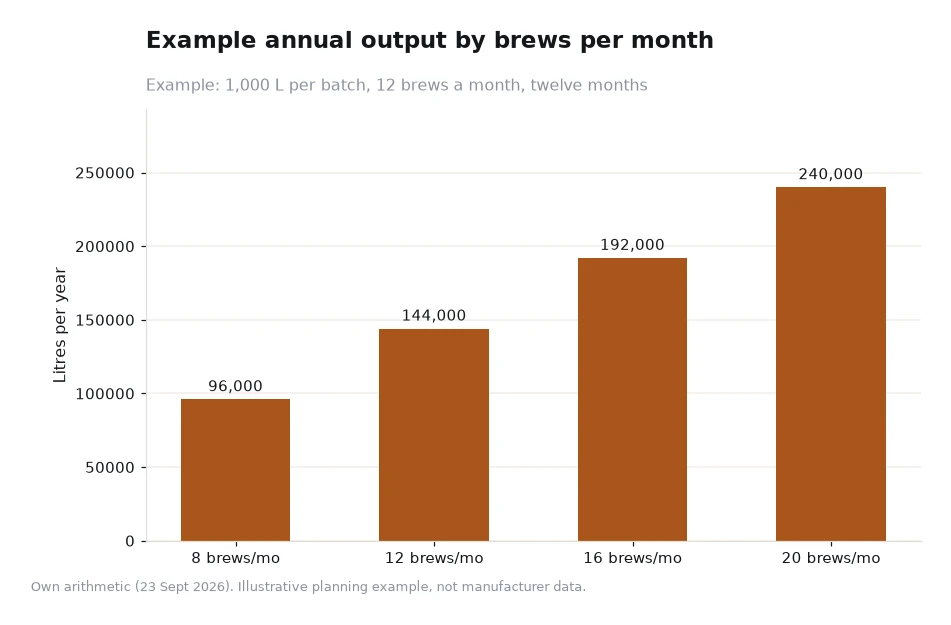
Worked example, with every assumption written out. A 1,000 L brewhouse, a size the manufacturer publishes, runs a 1,000 L batch 12 times a month for twelve months. Arithmetic: 1,000 L multiplied by 12 brews gives 12,000 L a month; 12,000 L multiplied by 12 months gives 144,000 L a year. Using the published conversion of 1 BBL at about 117 L, that is 144,000 divided by 117, or roughly 1,231 BBL a year, measured as gross kettle volume.
The chart below plots the same style of example at four intensities: 8 brews a month gives 96,000 L, 12 gives 144,000 L, 16 gives 192,000 L and 20 gives 240,000 L across twelve months.
Now add one assumption of my own, clearly labelled as such. If 10% of the volume stays behind as trub, yeast and tank bottoms, packaged beer is 144,000 L multiplied by 0.90, which is 129,600 L a year, or about 1,108 BBL. The chart plots gross batch volume; the packaged figure is a planning adjustment rather than a manufacturer number. Both figures matter, because the first sizes the brewhouse and the second sizes the bright tank and the filler.
Frequently asked questions
How long does delivery take from deposit to door?
The published lead time is 90 to 150 days from deposit to door delivery, and it varies with the order, so a single-vessel nano set and a multi-vessel brewery with a full tank farm do not sit in the same window.
What should I check first when the shipment arrives?
Open the checking list that accompanies the shipment, match the case numbers to the load plan, photograph the data plate on each tank, and only then start unloading.
What to send with the enquiry
Send the manufacturer your site access constraints, door and ceiling heights, the case numbering you want and the date your floor and utilities will be ready. The company profile sets out the 23 years of design work and the markets already served, while the brewery equipment range shows the sizes from 200 L to 10,000 L that are packed and inspected this way. For the published sizes from 200 L to 10,000 L, the hem brew system overview is the sensible starting point. If the container is already being planned, the contact page is the quickest route to a load plan and a checking-list template.
The figures in this article come from the manufacturer's own website, read 23 Sept 2026: the five inspection steps, the packing in wooden boxes with a checking list, the data plate carrying the pressure-testing record and serial number, the warranty wording of 6 years on tank accessories and electronic components against manufacturing defects from the factory used within scope, and the 90 to 150 day delivery window.[1] The output numbers in the chart and the worked example are labelled planning arithmetic, not manufacturer data.